
 Updated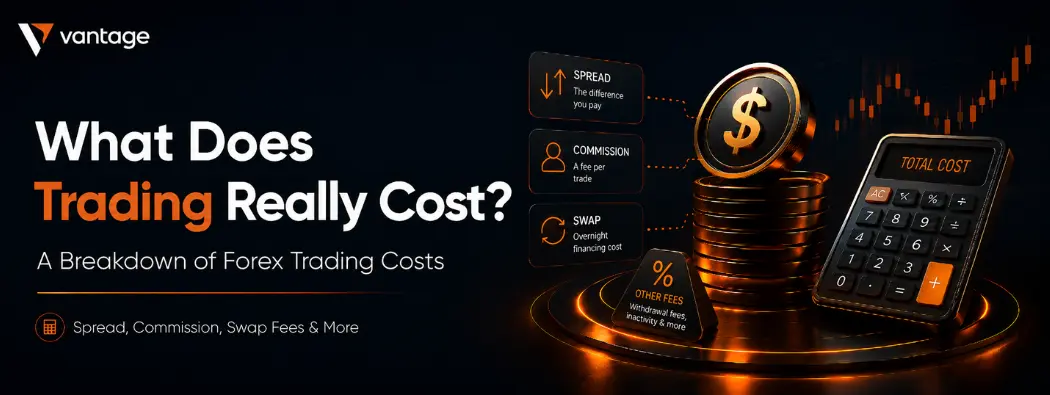
Many new traders focus on the spread when trying to understand the cost of trading forex.
The problem is that the spread is only one part of the total cost picture. Depending on your account type and trading style, other charges may affect the outcome of a trade.
When trading forex via CFDs, costs can include spreads, commissions, overnight swap fees, and certain account-related charges.
For South African traders, understanding these costs before funding a live account can make it easier to compare accounts and avoid unexpected expenses.
The most useful question is not, “What is the spread?” It is, “What is the total cost of opening, holding, and closing a trade?”
What Does Forex Trading Really Cost?
The cost of forex trading typically includes the spread, any commissions charged on the trade, and overnight swap fees if a position is held overnight.
Additional non-trading costs may include deposit, withdrawal, inactivity, and currency conversion fees.
Together, these costs determine a trade’s break-even point and affect the total cost of trading.
Before funding an account, consider practising on a demo account and reviewing the broker’s fees page to understand how trading costs are applied.
What Makes Up the Cost of Forex Trading?
The cost of forex trading consists of the spread, any commissions charged on the trade, overnight swap fees, and certain non-trading fees.
Many beginners focus on a single cost, usually the spread. In reality, the total cost of trading can come from several sources depending on your account type, how often you trade, and how long you keep positions open.
These costs matter because they affect your break-even point. Before a trade can generate a profit, it must first cover the costs of entering, holding, and exiting the position.
The table below shows the main costs that forex traders may encounter when trading CFDs.
| Cost Type | What It Is | When It Applies |
| Spread | The difference between the buy and sell prices | When opening and closing a trade |
| Commission | A separate fee is charged on some account types | Usually on raw or ECN-style accounts |
| Swap Fee | An overnight financing adjustment | When a position is held overnight |
| Slippage | Execution at a different price than expected | During fast-moving or low-liquidity markets |
| Deposit and Withdrawal Fees | Charges related to funding or withdrawing from an account | When moving money in or out |
| Currency Conversion Fees | Costs linked to converting one currency into another | When account and funding currencies differ |
| Inactivity Fees | Charges applied after a period of no trading activity | On some trading accounts |
The sections below explain each cost briefly and show where to find more detailed information and current fee schedules.
The Spread
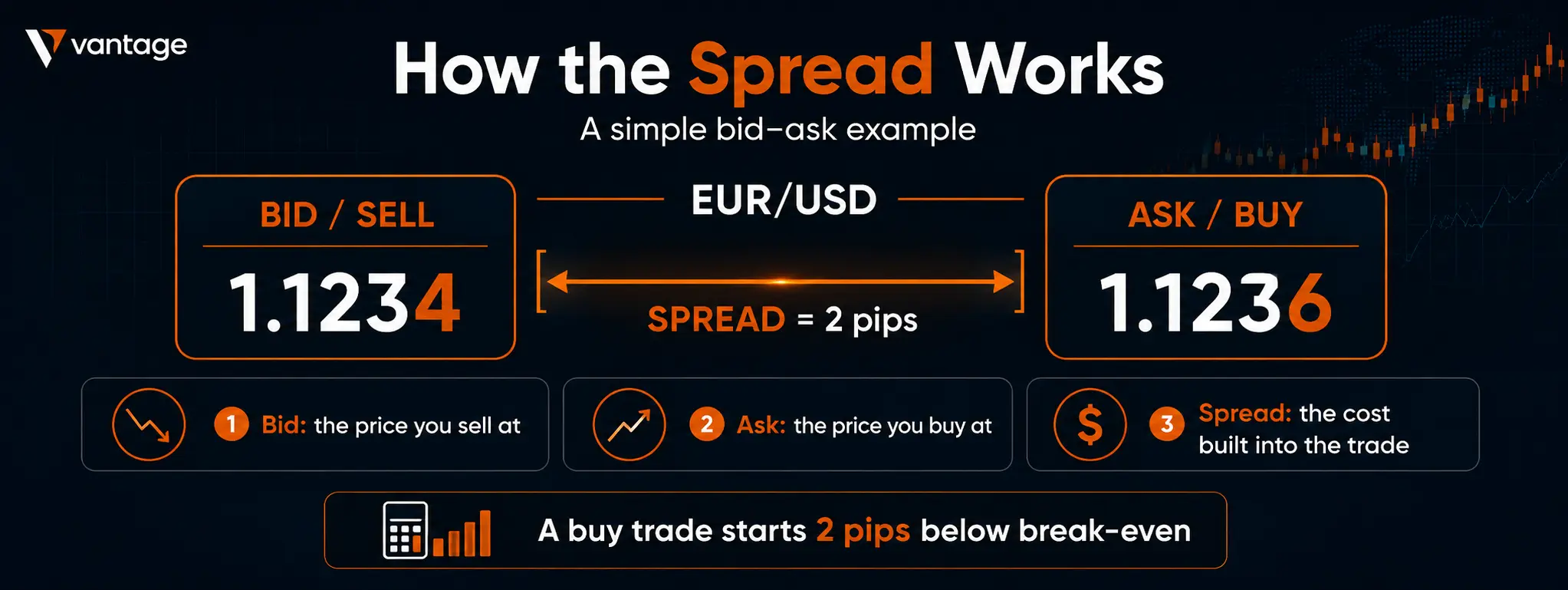
The spread is the difference between the buy price (ask) and the sell price (bid) of a currency pair.
It is one of the most common forex trading costs and is built directly into the market quote. When you open a trade, the position typically starts with a small unrealised loss equal to the spread because you buy at one price and sell at another.
The size of the spread can vary depending on market conditions, liquidity, and the account type being used. Some accounts include the spread as the main trading cost, while others combine lower spreads with a separate commission.
If you would like a deeper explanation of how spreads work and how they are measured, read our guide on what the spread is in forex trading.
Commission
A commission is a separate trading fee charged on certain account types, usually raw spread or ECN-style accounts.
Unlike a spread-only account, where the trading cost is built mainly into the bid and ask prices, a commission account may offer tighter spreads and charge a fixed fee to execute the trade. This fee is often calculated per lot traded and may be charged when opening and closing a position.
It is important to consider the total cost rather than focusing solely on the spread. An account that advertises very low, or even zero, spreads may still charge a commission, which is part of the overall trading cost.
To learn more about how these fees are calculated, read our guide to how forex commissions work.
Swap or Overnight Fees
Swap fees are financing adjustments that may apply when a forex CFD position is held overnight.
When you keep a trade open past the market rollover time, a swap charge or credit may be applied to your account. The amount depends on factors such as the currency pair being traded, the direction of the position, and the interest rate differential between the two currencies.
For short-term traders who close positions within the same day, swap fees may have little impact. For traders who hold positions for several days or weeks, they can become a more significant part of the total trading cost.
Some brokers also offer swap-free or Islamic accounts. These accounts are designed for traders who follow Sharia law and do not wish to pay or receive overnight interest-based adjustments.
To learn more, read our guides on swap or overnight fees and swap-free trading accounts. For current charges, refer to the broker’s live swap-rate pages.
Slippage
Slippage occurs when a trade is executed at a different price from the one you expected.
This can happen during periods of high market volatility, major news releases, or when liquidity is limited. In these situations, prices may move between the moment an order is placed and the moment it is filled.
Slippage is not a fixed fee charged by a broker. Instead, it is an execution cost that can affect the final entry or exit price of a trade. Depending on market conditions, slippage can be either positive or negative.
Although it is not part of every trade, it is still an important cost to understand when assessing the total cost of trading forex CFDs.
For a more detailed explanation, read our guide on slippage in trading.
The Hidden Costs (Deposit, Withdrawal, Inactivity, Conversion)
The hidden costs of forex trading are usually account-related fees rather than trading fees.
Many traders pay close attention to spreads and commissions but overlook the costs that can arise when funding, maintaining, or withdrawing from an account. These fees may not apply to every trader, but they are still worth checking before opening a live account.
Deposit fees are charges that may apply when adding funds to a trading account. Some funding methods are free, while others may carry processing costs.
Withdrawal fees may apply when transferring funds from a trading account. The amount often depends on the payment method used.
Some brokers may charge inactivity fees if an account remains unused for an extended period. Not all brokers apply these fees, which is why it is important to review the fee schedule carefully.
Currency conversion fees can arise when deposits, withdrawals, or trading activity involve different currencies. For South African traders, a ZAR-denominated account and local payment methods may help minimise the need for currency conversion.
For more information, review the broker’s withdrawal policies and fees page before funding an account.

The All-in Cost: A Worked Example
The real cost of a forex trade is the combined cost of the spread, commission, and any overnight swap fees.
Looking at only one cost can give an incomplete picture. A better approach is to calculate the total cost of entering, holding, and closing a position.
Consider the following illustrative example. These figures are examples only and do not represent current broker rates.
A trader opens a 1-lot EUR/USD CFD position.
- Spread cost: $8
- Commission: $6 round turn
- Overnight swap fee: $3 for holding the trade overnight
In this example, the total trading cost would be:
| Cost Component | Illustrative Cost |
| Spread | $8 |
| Commission | $6 |
| Swap Fee | $3 |
| Total Cost | $17 |
The all-in cost of the trade is $17.
This amount also affects the trade’s break-even point. Before the position can generate a net profit, it must first recover the $17 spent on trading costs.
The exact figures will vary depending on the currency pair, account type, position size, and holding period. That is why traders should avoid relying on headline spreads alone when comparing trading costs.
To estimate costs using current market conditions, use the trading calculator and refer to the broker’s live commission and swap-rate pages.
How Costs Differ by Account Type
Forex trading costs can vary significantly depending on the account type you choose.
In broad terms, most forex CFD accounts fall into two categories: spread-only accounts and commission-based raw-spread accounts.
| Account Type | Typical Cost Structure | Common Use Case |
| Standard / Spread-Only | Trading costs are mainly built into the spread | Traders who prefer a simpler pricing model |
| Raw / ECN-Style | Lower spreads combined with a separate commission | Traders who want direct visibility of spread and commission costs |
Neither structure is automatically cheaper in every situation. The total cost depends on factors such as trading frequency, position size, and the markets being traded.
This is why experienced traders often compare the all-in cost rather than focusing on the spread or commission in isolation.
If you are comparing different account structures, review the broker’s account types and zero-spread account resources. These guides explain how pricing models work and what costs may apply under each setup.
The key point is that different account types package trading costs differently, even when the total cost may be similar.
How Costs Differ by Trading Style
Trading costs affect different traders in different ways, depending on how long positions are held.
Day traders typically feel the impact of the spread and any commission most directly. Since they open and close positions on the same trading day, these costs are incurred repeatedly and can constitute a significant portion of overall trading expenses.
Swing traders and position traders often pay closer attention to overnight swap fees. A position held for several days or weeks may accumulate financing charges that become more noticeable over time.
Trading frequency also plays a role. A trader who executes many trades each week may be more sensitive to entry and exit costs than someone who trades less often.
This does not mean one trading style is more expensive than another. It simply means that different costs tend to have a greater impact depending on how a trader approaches the market.
Understanding which costs are most relevant to your trading style can make it easier to assess the true cost of trading forex CFDs.
How to Compare and Reduce Trading Costs
The best way to compare trading costs is to look at the all-in cost of a trade rather than focusing on a single fee.
Many traders compare brokers using the headline spread alone. A more complete comparison includes the spread, any commission, potential swap charges, and relevant non-trading fees.
It is also worth checking how costs are structured across different account types. Some accounts include most costs in the spread, while others separate the spread from the commission.
Non-trading fees deserve attention as well. Deposit methods, withdrawal options, inactivity policies, and currency conversion charges can all influence the total cost of maintaining an account.
For South African traders, using a ZAR-denominated account and local funding methods may help reduce conversion-related costs.
Before opening a live account, it can also be useful to review the broker’s fees page and test the platform in a demo environment. This allows traders to become familiar with pricing, order execution, and trading costs before committing real funds.
Risk Reminder
Lower trading costs do not guarantee better trading outcomes. Trading decisions, risk management, market conditions, and position sizing remain important factors when trading forex CFDs.
Why a Demo Helps You See Real Costs First
A demo account allows traders to understand how trading costs work before risking real money.
Many beginners read about spreads, commissions, and swap fees but do not fully understand how these costs are reflected on a trading platform. A demo account provides an opportunity to see how positions are priced, how spreads affect entries, and how trading costs influence results.
It can also help traders become familiar with trade tickets, account information, and platform features in a risk-free simulation environment.
Although a demo account does not replicate every aspect of live-market trading, it can be a useful way to learn how different costs are displayed and calculated.
Before funding a live account, consider opening a demo account to gain practical experience with forex CFD trading costs. Once you are comfortable with the platform and pricing structure, you can review the broker’s account types and live-account options.
Conclusion
The real cost of forex trading is not just the spread. It is the combined cost of the spread, any commission, overnight swap fees, and relevant account-related charges.
Understanding these costs can help South African traders compare accounts more effectively and develop a clearer picture of what a trade may actually cost.
The most useful approach is to focus on the all-in cost rather than any single fee. This includes considering how trading costs affect a position’s break-even point and how different account types package those costs.
Before opening a live account, take time to review the broker’s fees page, explore the trading calculator, and understand the costs that may apply to your trading style.
A demo account can be a practical first step. It allows you to see how trading costs appear on the platform and gain experience before committing real funds to forex CFD trading.
Frequently Asked Questions
What are the main costs of forex trading?
The main costs of forex trading are the spread, commission, and overnight swap fees. Traders may also incur non-trading costs, such as deposit, withdrawal, and inactivity fees, as well as currency conversion charges.
How much does forex trading cost per lot?
The cost per lot varies depending on the currency pair, account type, trade size, and holding period. The total cost usually consists of the spread, any commission charged, and applicable swap fees.
Can you trade forex for free?
No, forex trading is not completely free. Even when there is no separate commission, the spread is typically built into the trade. Other charges may also apply depending on the account and funding method used.
What is the difference between spread and commission?
The spread is the difference between the buy and sell price of a currency pair. A commission is a separate fee charged on certain account types, usually raw-spread or ECN-style accounts.
What are swap fees in forex trading?
Swap fees are overnight financing adjustments applied when a position remains open past the daily rollover time. Depending on the trade and market conditions, a swap may result in either a charge or a credit.
What hidden fees should forex traders watch for?
Common non-trading fees include deposit, withdrawal, inactivity, and currency conversion fees. These costs may not affect every trader, but they should be reviewed before funding a live account.
How can South African traders reduce trading costs?
South African traders can compare the all-in cost of trading, review non-trading fees carefully, and consider using a ZAR-denominated account or local funding methods to reduce conversion-related costs.
Does a demo account show trading costs?
Yes. A demo account can help traders see how spreads and other trading costs appear on the platform. It is a useful way to learn how pricing works before trading with real funds
Is forex trading expensive?
Forex trading costs vary depending on the account type, trading style, and market being traded. Rather than focusing on whether trading is expensive, it is more useful to understand the all-in cost of each trade.
Risk Warning: CFDs are complex financial instruments and carry a high risk of rapid loss of money due to leverage. You should ensure you fully understand the risks involved and carefully consider whether you can afford to take the high risk of losing your money before trading.
Disclaimer: The information is provided for educational purposes only and doesn’t take into account your personal objectives, financial circumstances, or needs. It does not constitute investment advice. We encourage you to seek independent advice if necessary. No representation or warranty is given as to the accuracy or completeness of any information contained within.
This material may contain historical or past performance figures and should not be relied on. Furthermore, estimates, forward-looking statements, and forecasts cannot be guaranteed. The information on this site and the products and services offered are not intended for distribution to any person in any country or jurisdiction where such distribution or use would be contrary to local law or regulation.
References
- https://www.vantagemarkets.com/en-za/trading/fees/spreads/ – Vantage spreads.
- https://www.vantagemarkets.com/trading/fees/commission/ – Vantage commissions.
- https://www.vantagemarkets.com/trading/fees/swap-rates/ – Vantage swap rates.
- https://www.vantagemarkets.com/en-za/terminology/slippage/ – Vantage slippage.
- https://helpcenter.vantagemarkets.co.uk/hc/en-gb/articles/11933259198095-Are-there-any-fees-for-making-a-deposit-at-Vantage – Are there deposit fees at Vantage?
- https://helpcenter.vantagemarkets.co.uk/hc/en-gb/articles/11933259198095-Are-there-any-fees-for-making-a-deposit-at-Vantage – Are there fees for withdrawals at Vantage?
- https://www.vantagemarkets.com/en-za/trading/fees/trading-calculator/ – Vantage forex profits calculator.
- https://www.vantagemarkets.com/en-za/trading/accounts/ – Vantage trading accounts.
- https://www.vantagemarkets.com/en-za/trading/accounts/ – Vantage Pro-ECN account.
- https://www.vantagemarkets.com/en-za/trading/accounts/demo/ – Vantage demo account trading.