Register
 Login
Login Register



In the forex trading industry, traders exchange one currency for another, with the exchange rate determined by the supply and demand for the traded currencies. According to the BIS Triennial Central Bank Survey, daily OTC FX market trading reached $7.5 trillion in April 2022, a 14% increase from $6.6 trillion in April 2019 [1].
It’s important for traders to understand forex rollover rates, as it can potentially impact your trading earnings. This beginner’s guide will help you understand what forex rollover rates are and how they work.
What is the Rollover Rate
Rollover rate is a crucial aspect of forex trading that relates to the interest earned or paid on a currency position held overnight by a trader [2]. This rate is influenced by the disparity in interest rates between the two currencies in the traded pair. Factors such as central bank policies, global economic conditions and fluctuating interest rates are a few examples of elements that can impact the rollover rates.
Typically, any currency position that remains open after 17:00 EST will be held overnight, and the rollover rate is calculated [3]. As the rollover rate can affect trading costs, and consequently impact profits or losses (especially for positions held over an extended duration), it is crucial for traders in the forex market to gain a comprehensive understanding of this concept.
Understanding Rollover Rate
To understand the rollover rate, traders must first identify the base and quote currencies in a currency pair and their corresponding interest rates. The interest rate differential can be calculated by subtracting the quote currency’s interest rate from the base currency’s interest. This differential is then converted into a daily rate to account for overnight-held positions.
Read more about the different types of currency pairs available for you to trade here.
The rollover amount is determined by multiplying the daily interest rate differential by the position size.
Based on whether a trader holds a long position or short position on a currency pair, they will either receive or pay the rollover amount, respectively [4]. It is worth noting that brokers might impose a spread or additional fees, which can slightly modify the actual rollover rate.
Rollover Rate Formula
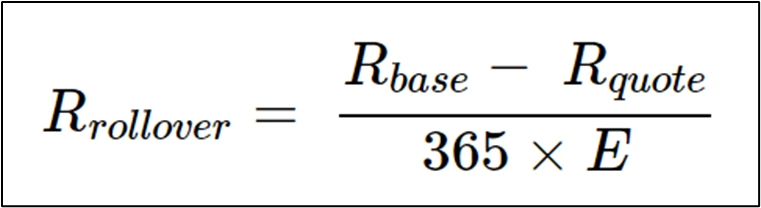
Rrollover = The rollover rate
Rbase = Interest rate for the base currency
Rquote = Interest rate for the quote currency
E = Exchange rate
The first currency code in the currency pair is referred to as the base currency. The second currency is called the quote currency. Base and quote currency interest rates refer to the short-term lending rate among banks in the country of the currency.
How to Calculate Rollover Rate
Here’s a step-by-step guide to calculate the rollover rate for a forex position:
1. Identify the currency pair:
Begin by identifying the currency pair that you are interested in trading. There is a wide selection and in this case, we select the EUR/USD currency pair as an example.
2. Determine the base and quote currency interest rates:
Research the central bank’s interest for the currency pair with EUR as the base currency and USD as the quote currency. The interest rates are assumed to be as follows:
- EUR interest rate: 1.0%
- USD interest rate: 0.25%
3. Calculate the interest rate differential:
The quote currency’s interest is subtracted from the base currency’s interest rate.
- Interest rate differential: 1.0% (EUR) – 0.25% (USD) = 0.75%
4. Convert the interest rate differential to a daily rate:
Divide the interest rate differential by the number of days in a year. In most calculations, the total number of days in a year is assumed to be 365. This is how the interest rate differential can be converted to a daily rate.
- Daily interest rate differential: 0.75% / 365 = 0.00205%
5. Determine your position size:
Determine the position size of your trades. This will be the number of units or lots you are trading. Assume you are trading 100,000 units of EUR/USD currency pair.
6. Calculate the rollover amount:
The rollover amount is calculated by multiplying the position size with the daily interest rate differential.
- Rollover amount: 100,000 * 0.00205% = 20.5
7. Apply the rollover amount:
If you are trading long on the currency pair, you will earn the rollover amount.
If you are trading short on the currency pair, you will be required to pay the rollover amount.
Rollover Rate vs. Swap Rate
The swap rate refers to the interest rate differential between two currencies that are being traded. It determines the cost or revenue that will be generated when holding a currency pair overnight. Simply put, it is the rate at which interest in one currency is exchanged for interest in another currency.
On the other hand, the rollover rate is also known as a swap fee, which is charged or credited to a trader’s account when they hold a position open overnight. The rollover rate is a result of the difference between the interest rates of the two currencies being traded.
In summary, swap rate and rollover rate are closely related, but they have different meanings. The swap rate is the interest rate differential between the two currencies being traded, while the rollover rate is the fee charged or credited to a trader’s account for holding a position open overnight.
Here’s a table to show the difference between the rollover rate and the swap rate:
| Aspect | Rollover Rate | Swap Rate |
| Definition | The interest earned or paid on a currency position held overnight by a trader. | The interest rate differential between two currencies that are being traded. |
| Relation | The rollover rate is a result of the difference between the interest rates of the two currencies being traded. | The swap rate is the interest rate differential between the two currencies being traded. |
| Fee | The rollover rate is charged or credited to a trader’s account when they hold a position open overnight. | The swap rate impacts the cost or revenue generated when holding a currency pair overnight. |
Final Thoughts
Rollover rates can have a significant impact on trading profits and costs, especially for positions held over an extended duration. By learning how to calculate rollover rates, traders can have a better understanding when opening and closing their trade positions. Now that you’ve gained a clear understanding of forex rollover rates, it might be time to elevate your trading experience with a live account. Get started with Vantage today and enjoy the advantages of trading forex. With a minimum deposit of just $50 and spreads from 0.0, our live account offers you the advantage of low spreads. Take action now and seize the opportunity to start trading!
References
- “OTC foreign exchange turnover in April 2022 – BIS”. https://www.bis.org/statistics/rpfx22_fx.htm. Accessed 3 May 2023.
- “Rollover Rate (Forex): Overview, Examples, and Formulas – Investopedia”. https://www.investopedia.com/terms/r/rollover-rate.asp. Accessed 3 May 2023.
- “Rollover Rate (Forex): Overview, Examples, and Formulas – Investopedia”. https://www.investopedia.com/terms/r/rollover-rate.asp. Accessed 3 May 2023.
- “What Does Rollover Mean in the Context of the Forex Market? – Investopedia”. https://www.investopedia.com/ask/answers/06/rollover.asp. Accessed 3 May 2023.