Updated
Learning how to trade penny stocks means learning how to handle their risks first. These are shares priced under USD5, usually issued by small companies and traded over the counter, and their appeal is obvious: a small budget can buy thousands of shares, and a few cents of movement can mean a large percentage swing.
That same volatility, thin liquidity and light disclosure is also what catches inexperienced traders out. This guide walks through what penny stocks are, how to access them, where to find them, and — most importantly — the practical steps traders use to manage the risks before placing a single trade.
Key Points
- Penny stocks are shares trading under USD5, typically on over-the-counter markets, and are considered highly speculative because of low liquidity, high volatility and limited company disclosure.
- You can access penny stocks through an OTC-enabled brokerage, or, where available and permitted under applicable laws and regulations, gain indirect exposure to their price movements through Contracts for Difference (CFDs) without owning the underlying shares.
- Managing the risk — through research, position sizing, limit orders and awareness of pump-and-dump scams — matters more with penny stocks than with almost any other asset class.
What are penny stocks?
Penny stocks are shares issued by small-cap companies that trade for under USD5 per share. The U.S. Securities and Exchange Commission (SEC) formally defines a penny stock as a low-priced security, generally trading below USD5, that is not listed on a national exchange, under Rule 3a51-1 [1].
A small number of penny stocks appear on major exchanges such as the New York Stock Exchange (NYSE) or Nasdaq, but most trade through over-the-counter markets (OTC) — decentralised dealer networks rather than a central exchange [2].
Because OTC-traded companies face lighter reporting requirements and are often very small, penny stocks tend to trade infrequently and carry low liquidity. Combined, these traits make them far more speculative and volatile than mid-cap or large-cap shares.
How to trade penny stocks
You can start trading penny stocks by opening an account with an online brokerage that offers OTC trading. Many brokerages now include OTC access as standard, letting customers buy and sell penny stocks directly through their platform. Alternatively, a traditional stockbroker can place OTC trades on your behalf, though this usually carries a higher fee.
You can also gain indirect exposure to penny stock price movements through financial derivatives such as share Contracts for Difference (CFDs), options and futures. A Contract for Difference (CFD) lets you take a position on whether a price will rise or fall without owning the underlying share.
With a CFD, if you expect the price to rise you can open a long position; if you expect it to fall you can open a short position. You only make a gain if the price moves in the direction of your trade — and because CFDs are leveraged, both gains and losses are magnified relative to your initial outlay. If the price moves against you, losses can exceed your initial deposit.
New to placing trades? Our 5-step guide to trading stocks online covers the mechanics of opening and managing a position.
How to trade penny stocks while managing the risk
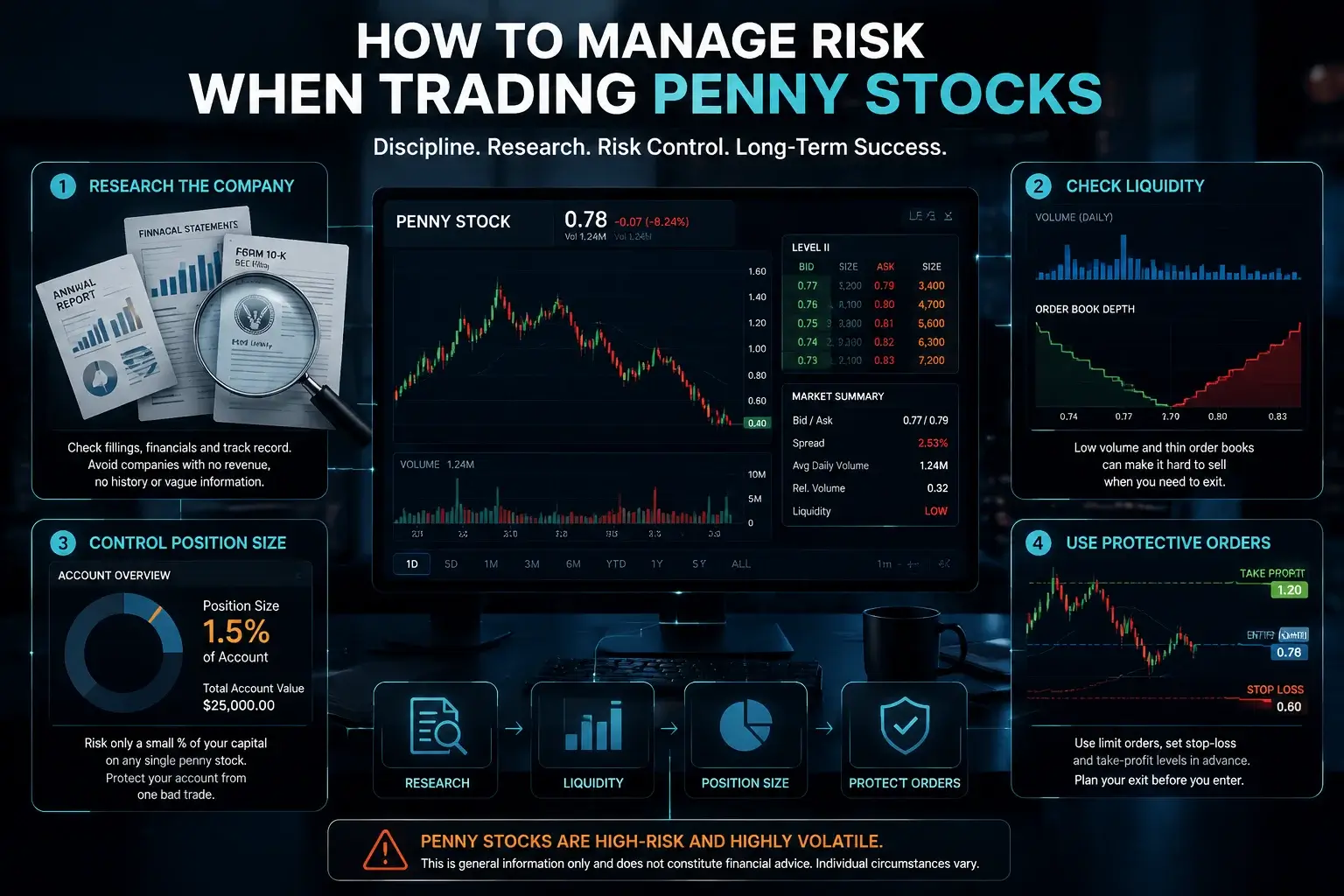
There is no such thing as risk-free penny stock trading — the asset class is speculative by nature. But traders who last tend to follow a disciplined process rather than chasing tips. The steps below are the risk controls most commonly cited by brokers and market regulators.
Research the company before you trade
Read whatever filings exist. Penny stocks listed on the higher OTC tiers publish more financial information than those on the open Pink tier, which may file nothing at all [3]. Treat any stock you cannot research as higher risk, and be sceptical of companies with no revenue, no track record, or promotional press releases in place of financial statements.
Check liquidity before entering
Look at a stock’s average daily trading volume before you buy. If a stock barely trades, you may be unable to sell your holding at your desired price — or at all — when you want to exit [5]. Understanding liquidity in the market is central to trading penny stocks, because low liquidity is what turns a paper gain into a position you cannot close.
Size positions small and use orders that protect you
A widely used principle is to commit only a small percentage of trading capital to any single penny stock, so one failed position cannot damage the whole account. Using limit orders rather than market orders helps control the price you pay in fast-moving, wide-spread markets, and having a predefined exit point for both profit and loss removes emotion from the decision. This is general information only and does not constitute financial advice. Individual circumstances vary.
Learn broader risk-management technique
The habits that protect a penny stock trader are the same ones used across every asset class. Our guide to risk-management techniques covers position sizing, stop levels and managing exposure in more detail, and applies directly to the volatility you will meet in penny stocks.
Why do traders buy penny stocks?
The low price is the headline attraction: a modest budget can buy several thousand shares, where the same amount might buy only a handful of shares in a large-cap company.
Day trading penny stocks can also offer the potential for larger percentage swings because of their higher price volatility. When a penny stock’s price moves sharply, the wide swings can amplify trading outcomes — but downside exposure is amplified to exactly the same degree, and a losing trade can be severe.
A third draw is the long-shot possibility of lasting returns if a small company grows into a stable, established business. Companies such as some of today’s technology giants once traded at low prices in their early history — though for every one that succeeds, many more fail. Past performance is not a reliable indicator of future results.
How to find penny stocks
Because most penny stocks are not listed on major exchanges, newcomers often wonder where to look. A common starting point is the OTC Markets Group platform, which provides pricing and quotation data for roughly 10,000 OTC securities [2]. These are organised into tiers — OTCQX for more established companies with fuller disclosure, OTCQB for smaller reporting companies, and the open Pink market, which has no financial disclosure or reporting requirements [3].
Financial news portals and stock screeners also track active penny stocks by exchange and sector, which can help you filter by price, volume and float. Discussion boards and blogs exist too, but treat recommendations there with caution — coordinated promotion is one of the ways penny stock scams begin.
Examples of penny stocks by sector
Because a penny stock is defined only by its price, you can find them across many industries. Rather than naming individual companies — whose prices and listings change constantly — it is more useful to recognise the sectors where penny stocks cluster.
| Sector | Why penny stocks appear here |
| Biotechnology & pharmaceuticals | Early-stage drug developers with no revenue yet, priced on trial outcomes |
| Mining & resources | Junior explorers whose value hinges on discovery and commodity prices |
| Technology & hardware | Small-cap firms commercialising unproven products |
| Cannabis & emerging industries | Newer, lightly capitalised companies in fast-changing regulatory environments |
Where to buy penny stocks
Several online brokerage platforms let traders access penny stocks. Before choosing one, research the features each offers — OTC access, fee structure, surcharges on low-priced shares, and any volume restrictions — to make sure the platform fits how you intend to trade.
As a multi-asset broker, Vantage offers traders exposure to share price movements through stock CFDs, where available and permitted under applicable laws and regulations. Opening a live account allows eligible clients to trade share CFDs and take a position on both rising and falling prices by going long or short, without owning the underlying shares. As with all leveraged products, this magnifies both potential gains and potential losses.
Risks of trading penny stocks
Penny stocks may offer unique propositions, but trading them is not without risk — and their nature heightens several risks in particular. Watch for the following.
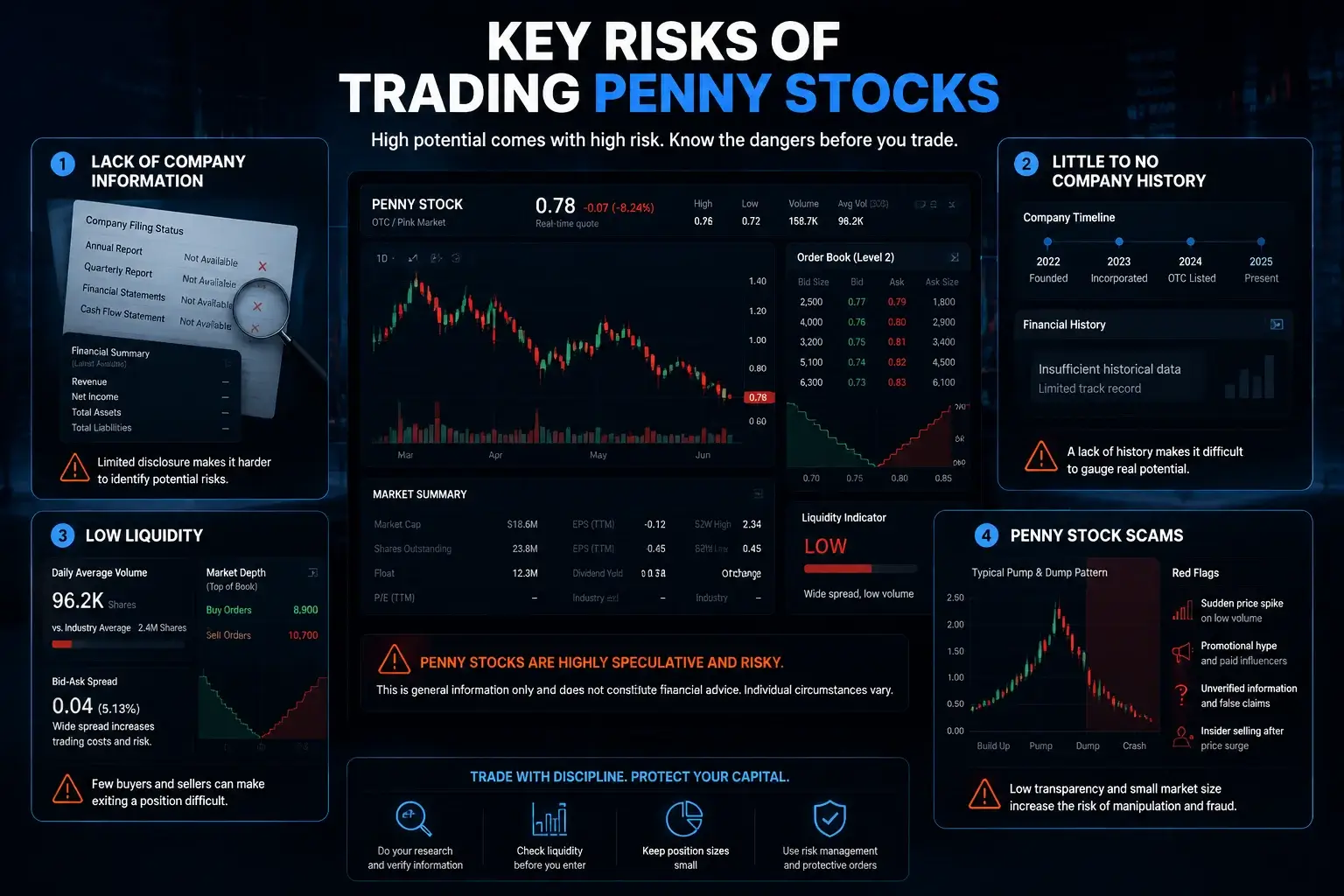
Lack of company information
Penny stocks are held to looser reporting standards than shares from larger, established companies. Less information is available — and what exists may be harder to verify — which puts traders at a disadvantage, as red flags can go unnoticed.
Little to no company history
Penny stocks are often newly formed or listed companies, or businesses near the end of their life. That lack of a track record makes it difficult to gauge a company’s real potential.
Low liquidity
Because penny stocks typically have low market capitalisation, traders face the risk of low liquidity. A lack of buyers can prevent you from closing a position — there may not be enough demand to absorb your shares, forcing you to accept a lower price or hold longer than intended.
Penny stock scams
Penny stocks carry a heightened risk of fraud. The difficulty of verifying a company’s background can leave traders unaware they are buying into a shell company with no real operations. Low market capitalisation also makes prices easy to manipulate, enabling pump-and-dump schemes in which promoters inflate a price and sell into the demand they created [4]. Some small companies also pay influencers or outlets to publish biased coverage to lift their share price artificially.
The Bottom Line on Trading Penny Stocks
Penny stocks are a highly volatile, high-risk asset class that carries dangers larger-cap shares do not — heightened scam risk, thin liquidity and limited, hard-to-verify information. They are not suitable for every trader.
Anyone trading or investing in penny stocks should do so only at a level of risk they can afford, apply sound risk management, and be cautious with leverage. Understanding how these markets work — and how to manage their risks — matters far more here than the low share price that first draws people in. This does not constitute a personal recommendation. Independent advice should be sought.
Frequently Asked Questions
How do you trade penny stocks safely?
There is no way to remove risk from penny stock trading, but you can manage it. That means researching a company’s filings before buying, checking its average daily volume to be sure you can exit, committing only a small share of your capital to any one position, and using limit orders with predefined exit points. Awareness of pump-and-dump scams is also essential, as penny stocks are especially prone to price manipulation.
How to trade penny stocks for beginners?
Beginners should start by opening an account with a brokerage that offers OTC trading, or, where available and permitted under applicable laws and regulations, use share CFDs to take a position on price movements without owning the shares. Before trading, it is worth learning how OTC markets work, how liquidity affects your ability to exit, and how to size positions conservatively. Penny stocks are widely considered unsuitable for those new to markets because of their volatility and limited disclosure.
How to invest in penny stocks?
You can access penny stocks through an OTC-enabled online broker or a traditional stockbroker. In jurisdictions where they are available and permitted under applicable laws and regulations, some traders may also gain indirect exposure through derivatives such as CFDs. Whichever route you choose, research the company and the platform’s fees first — some brokers add surcharges on low-priced shares. Because penny stocks are speculative, most guidance recommends limiting exposure to money you can afford to lose.
Where can I trade penny stocks?
Penny stocks trade mainly on over-the-counter markets such as the OTC Markets Group tiers, and a small number appear on major exchanges like the NYSE and Nasdaq. To access them you need a brokerage that supports OTC trading, or, where available and permitted under applicable laws and regulations, a broker offering share CFDs on eligible companies. Always confirm the platform’s OTC access and fee structure before opening an account.
Can you day trade penny stocks?
Yes, penny stocks are often day traded because their volatility can produce large intraday percentage moves. However, that same volatility, combined with thin liquidity and wide bid-ask spreads, makes day trading them particularly risky. Traders who day trade penny stocks typically rely on strict position sizing, fast execution and predefined exit levels.
Why are penny stocks considered high risk?
Penny stocks are high risk because they combine low liquidity, high volatility and limited disclosure. Many are issued by very small companies with little track record, and their low market capitalisation makes prices easy to manipulate. These factors mean a trader can lose part or all of their capital, and reliable information to assess the company is often scarce.
RISK WARNING: CFDs are complex financial instruments and carry a high risk of losing money rapidly due to leverage. You should ensure you fully understand the risks involved and carefully consider whether you can afford to take the high risk of losing your money before trading.
Disclaimer: The information is provided for educational purposes only and doesn’t take into account your personal objectives, financial circumstances, or needs. It does not constitute investment advice. We encourage you to seek independent advice if necessary. The information has not been prepared in accordance with legal requirements designed to promote the independence of investment research. No representation or warranty is given as to the accuracy or completeness of any information contained within. This material may contain historical or past performance figures and should not be relied on. Furthermore estimates, forward-looking statements, and forecasts cannot be guaranteed. The information on this site and the products and services offered are not intended for distribution to any person in any country or jurisdiction where such distribution or use would be contrary to local law or regulation.
References
- “Penny Stock Rule 3a51-1 — U.S. Securities and Exchange Commission” https://www.sec.gov/rules-regulations/statutes-regulations Accessed 2 July 2026
- “Penny Stocks and Over-The-Counter Trading — Investor information” https://www.investorlawyers.net/practice-areas/broker-fraud-securities-arbitration/penny-stocks-over-the-counter-trading/ Accessed 2 July 2026
- “What is Over-The-Counter (OTC)? — Robinhood Learn” https://robinhood.com/us/en/learn/articles/6v9qlwLEozNepDPD2ze1i/what-is-over-the-counter-otc/ Accessed 2 July 2026
- “Investing in penny stocks — Fidelity Viewpoints” https://www.fidelity.com/viewpoints/active-investor/trading-penny-stocks Accessed 2 July 2026
- “How to Invest in Penny Stocks — NerdWallet” https://www.nerdwallet.com/article/investing/how-to-invest-in-penny-stocks Accessed 2 July 2026