Updated
Copper sits behind almost everything that carries a current — power grids, air conditioners, electric vehicles, and the data centres now training artificial intelligence. That practical role is why more people are asking how to invest in copper, and why its price has behaved less like a sleepy industrial metal and more like a growth story.
You can gain copper exposure in several ways: buying the physical metal, trading copper futures, holding shares in copper mining companies, using an internationally listed copper exchange-traded fund (ETF), or taking a position on the copper price through Contracts for Difference (CFDs). Each route carries a different mix of cost, complexity, and risk.
This guide explains how those options work on the local exchanges and where the risks sit — it does not tell you which one to choose.
Key Points
- Copper is an industrial metal whose price tends to track the health of the global economy, so it behaves very differently from a safe-haven asset such as gold.
- There is no dedicated copper ETF listed on the local exchanges as of 2026, so domestic investors typically reach copper through futures on the MCX, mining shares, internationally listed funds, or copper CFDs.
- Every route to copper carries meaningful risk — price swings, leverage, futures roll costs, and company-specific factors — and copper is generally treated as a small, cyclical part of a wider portfolio rather than a core holding.
Why Copper Is Drawing Investor Attention
Copper is often nicknamed “Dr. Copper” because its demand spans so much of the real economy that its price can act as a barometer of global growth. When construction, manufacturing, and power investment expand, copper usage tends to rise; when activity cools, demand can soften just as quickly. That cyclicality is the first thing that separates copper from gold.
What has changed recently is the demand side. Electrification is copper-heavy: according to the International Energy Agency, an electric vehicle uses roughly 2.4 times more copper than a comparable combustion-engine car, and renewable power infrastructure can require between 2.5 and 7 times more copper than fossil-fuel-based generation [1].
The same report projects that clean-energy technologies could account for more than 40% of total copper demand within two decades [1]. A newer pull is coming from artificial intelligence: S&P Global notes that data centres could rise from around 5% to 14% of US electricity demand by 2030, with copper wiring the power and cooling systems behind them [2].
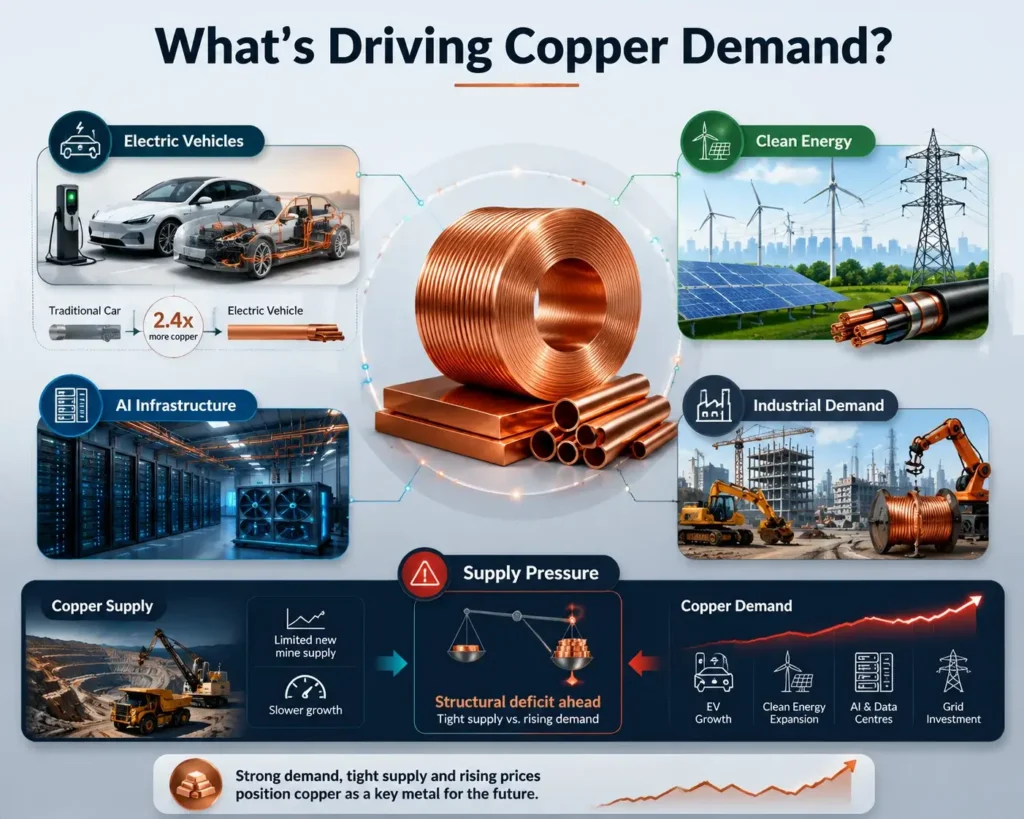
Supply has struggled to keep pace. The International Copper Study Group (ICSG) forecasts the global refined copper market will swing to a deficit of about 150,000 tonnes in 2026 — its first structural shortfall in years — against total refined usage of roughly 28.7 million tonnes [3].
Tight supply and firm demand pushed benchmark prices to record levels above US$14,000 per tonne on the London Metal Exchange in early 2026, with copper trading around US$13,300 per tonne by early July 2026 [4]. Rising prices, though, cut both ways: they can lift returns for copper holders while squeezing the industries that depend on the metal.
Ways to Invest in Copper
There is no single way to invest in copper; there are several, and they differ in how directly they track the metal’s price. Some routes hand you the physical commodity, others give exposure through companies or funds, and a few let you take a position on price movements without owning anything at all. The five approaches below are the ones most available through the local exchanges and international platforms.
Physical Copper
Buying physical copper means owning the metal itself — bars, cathodes, or coins bought from a dealer. It is the most direct form of ownership, but copper’s low value-to-weight ratio makes it impractical for most individuals: storing a meaningful amount takes far more space than the same value in gold, and dealers apply a spread between buying and selling prices. Physical copper tends to suit patient holders who are comfortable with storage and slower resale, rather than anyone wanting to move in and out quickly.
Copper Futures on the MCX
Copper futures are standardised contracts to buy or sell copper at a set price on a future date, traded domestically on the Multi Commodity Exchange (MCX). They offer direct exposure to copper prices and are actively used by traders who understand margin and leverage. Because contracts expire monthly and use leverage, futures demand active management and carry the risk of losses that can exceed the initial margin. They are generally regarded as a tool for experienced, shorter-term traders rather than long-term investors.
Copper Mining Shares
Buying shares in copper producers gives indirect exposure to the copper cycle: when copper prices rise, miners’ revenues and margins often rise too. On the local exchanges (NSE and BSE), most listed producers are diversified metals companies rather than pure copper plays, so their share prices reflect more than the copper price alone. Mining shares can also pay dividends and, unlike futures, have no expiry — but they add company-specific risks such as operating costs, strikes, and management decisions.
Copper ETFs and Fund-of-Funds
A copper ETF is an exchange-traded fund that tracks either copper mining companies or copper futures, letting investors gain copper exposure in a single listed instrument.
As of 2026, there is no dedicated copper ETF listed on the local exchanges — unlike gold and silver, copper lacks a domestic exchange-traded fund, partly because storing physical copper to back one is costly. Investors here typically access copper funds in two ways: through internationally listed ETFs using an overseas trading account, or through a domestic Fund-of-Funds (FoF) that invests in those international funds.
Internationally listed examples include miner-based funds such as the Global X Copper Miners ETF (COPX) and futures-based funds such as the United States Copper Index Fund (CPER); expense ratios vary and, as of 2026, typically range from roughly 0.5% to over 1% a year. Some multi-asset mutual funds also carry limited copper exposure, and Fund-of-Funds structures add a second layer of fees while simplifying access.
Copper CFDs
A Contract for Difference (CFD) is an agreement to exchange the difference in an asset’s price between when a position is opened and closed, without owning the underlying asset. A copper CFD lets a trader take a position on the copper price — long if they expect it to rise, short if they expect it to fall — with the position sized by leverage.
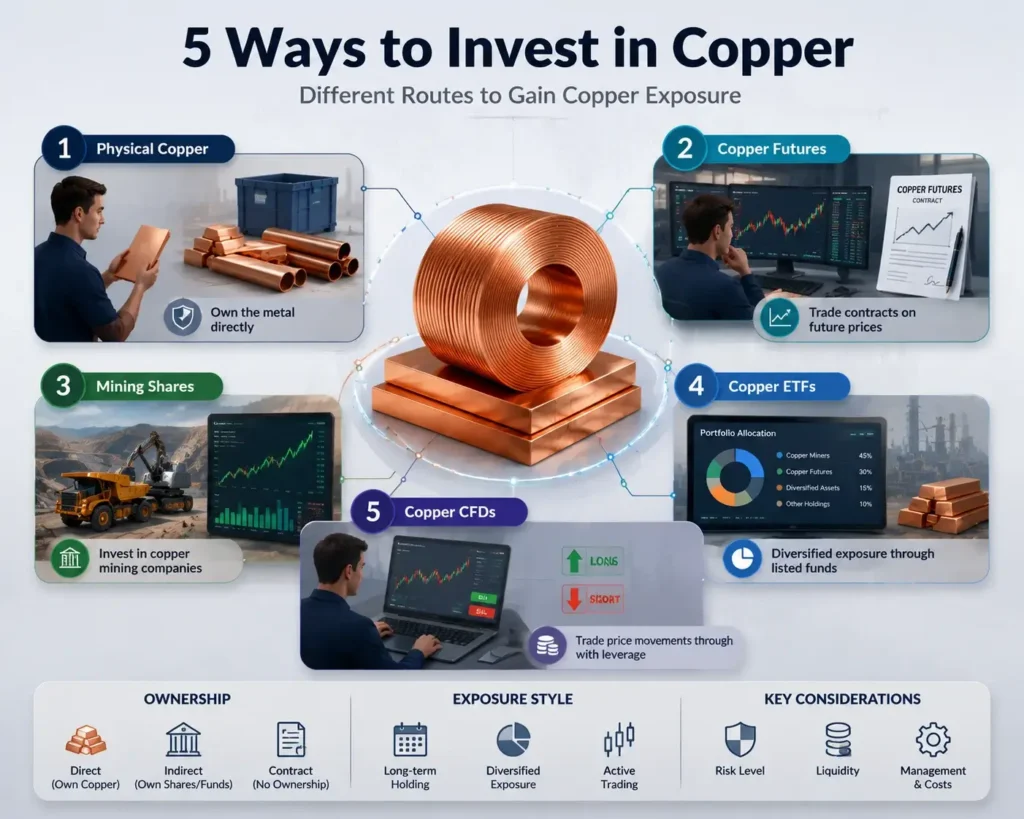
Because you never take delivery, there is no storage and no futures contract to roll manually. Leverage, though, magnifies both gains and losses, and copper’s volatility can move a leveraged position sharply in either direction. The next section looks at how copper CFDs work in more detail.
| Method | How you gain exposure | Ownership | Typical use |
| Physical copper | Buy and hold the metal | Direct | Long-term, tangible holding |
| Copper futures (MCX) | Contract on a future price | No (contract) | Active, shorter-term trading |
| Copper mining shares | Shares in producers | Company shares | Indirect, longer-term exposure |
| Copper ETFs / FoF | Fund tracking miners or futures | Fund units | Diversified, passive exposure |
| Copper CFDs | Contract on the price difference | No (contract) | Short or long price positions |
How Copper CFDs Work
Because CFDs are the route most directly tied to a broker platform, they are worth a closer look. With a copper CFD, you are speculating on the price movement of copper — quoted in US dollars per tonne — rather than buying the metal or a fund. You can open a long position if you expect prices to rise or a short position if you expect them to fall, which is harder to do with physical copper or most funds.
Leverage is central to how CFDs behave, and it is also the main risk. Leverage lets you control a larger position with a smaller deposit, called margin, but it magnifies both gains and losses in equal measure.
Consider a hypothetical position on a copper CFD at 20:1 leverage. A trader wanting exposure to US$10,000 of copper would need around US$500 of margin. If copper rises 5%, that US$500 controls a US$500 gain before costs; if copper instead falls 5%, the same position loses US$500 — the entire margin. The mechanic cuts both ways, which is precisely why leverage raises risk as much as potential reward.
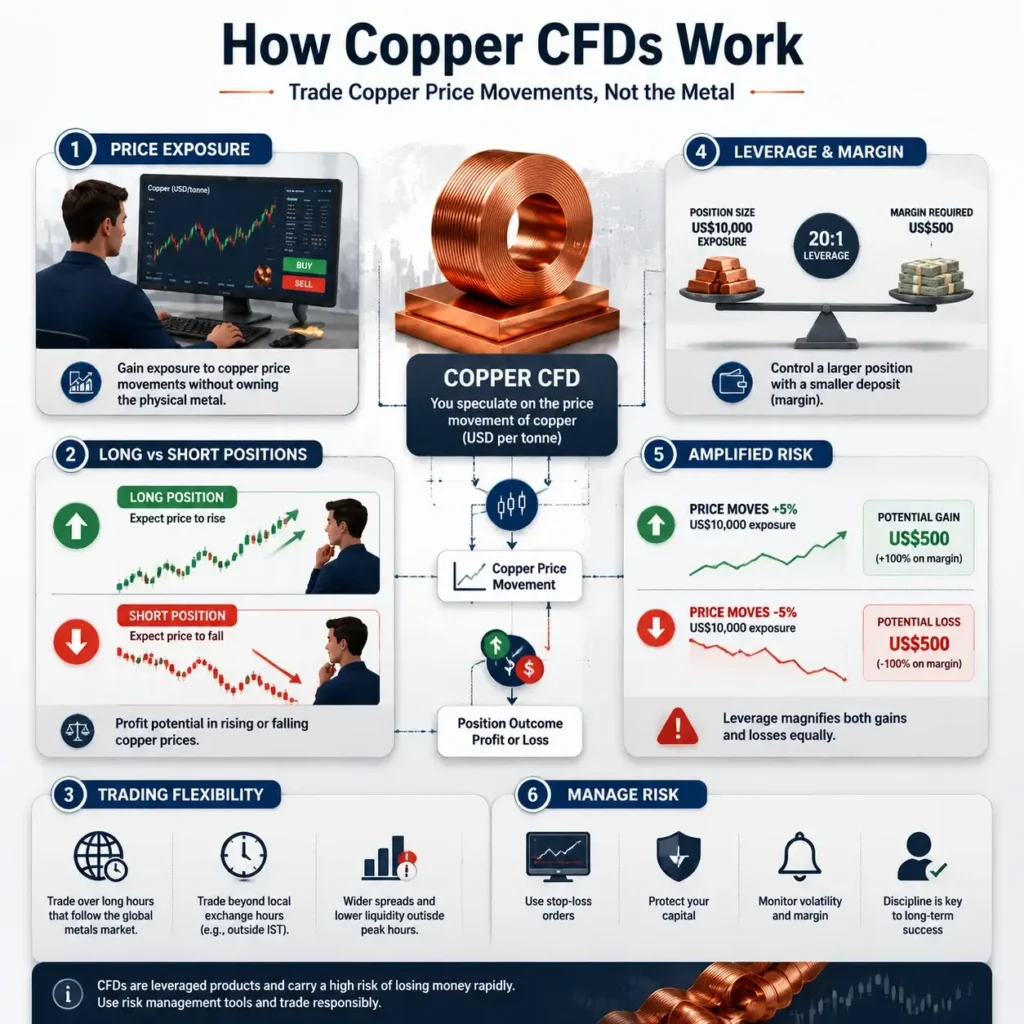
This example is hypothetical and for illustrative purposes only. It does not reflect actual trading results or client experiences.
Copper CFDs also trade over long hours that broadly follow the global metals market, so positions can be opened and closed well beyond the MCX session in local time (IST) — though wider spreads and lower liquidity are common outside peak hours.
Vantage offers copper among its metals CFDs, alongside gold and silver, on the MT4 and MT5 platforms. As with any leveraged product, that flexibility comes with the risk of rapid losses, so risk controls such as stop-loss orders are commonly used — though they do not guarantee execution at the set level in fast-moving markets.
The Risks of Investing in Copper
Copper’s appeal and its danger come from the same source: it moves with the economic cycle, and that cycle can turn quickly.
- Price volatility: Copper prices can swing sharply on shifts in global growth, Chinese demand — China accounts for around 58% of global copper usage [3] — mine disruptions, and currency moves. A metal that can rise on supply fears can fall just as fast when demand expectations weaken.
- Futures and CFDs both use leverage: this magnifies losses as much as gains. A leveraged position can lose more than the initial margin, and a margin call can force it closed at an inopportune time.
- Roll and tracking costs: Futures-based funds and contracts incur costs to roll expiring contracts forward, which can cause them to underperform the copper price over time. Mining shares can also diverge from copper, since company factors affect them independently.
- Company-specific and access risks: Mining shares carry operational and management risk, while international routes add currency exposure and the administrative steps of investing across borders.
Copper is not a safe-haven asset. Where gold is often held as a hedge in times of stress, copper tends to fall when growth fears rise, so it behaves more like a position on economic activity than a defensive holding.
Matching an Approach to Your Goals
Because each route carries a different balance of cost, control, and risk, the approach that fits depends on your goals, time horizon, and experience — not on which method looks most exciting.
- Investors seeking simple, longer-term exposure often look to funds or mining shares, accepting that neither tracks the copper price perfectly.
- Traders comfortable with leverage and active management may consider futures or copper CFDs, where short-term price moves — up or down — can be traded, with correspondingly higher risk.
- Those who value tangible ownership sometimes hold physical copper, provided they can manage storage and slower resale.
Whichever route is considered, copper is generally treated as a small, cyclical slice of a diversified portfolio rather than a core position. This is general information only and does not constitute financial advice; individual circumstances vary and independent advice should be sought.
Is Copper Exposure Right for Your Portfolio?
Copper’s investment case rests on a simple tension: demand from electrification, renewables, and AI infrastructure is climbing while new supply is slow to arrive, which has kept prices high and volatile into 2026.
For investors here, the practical question is less whether copper matters and more how to access it — through physical metal, MCX futures, mining shares, internationally listed ETFs, or copper CFDs — since no single domestic copper fund exists.
Each route trades convenience against cost and risk, and copper’s cyclical nature means sharp moves in both directions are part of the package. Understanding how each method works, and where the risk sits, matters more than picking the one that looks most promising.
Frequently Asked Questions
What is the best way to invest in copper?
There is no single best way — the routes differ by cost, complexity, and risk rather than by quality. Physical copper offers direct ownership but is impractical to store; futures and CFDs offer leveraged price exposure but carry higher risk; mining shares and internationally listed ETFs offer more indirect, longer-term exposure. The suitable route depends on your goals, time horizon, and experience, and this is general information rather than a personal recommendation.
Is there a copper ETF listed on the local exchanges?
As of 2026, there is no dedicated copper ETF listed domestically, unlike the well-established gold and silver ETFs. This is partly because backing an ETF with physical copper is costly given the metal’s bulk. Investors here generally reach copper funds through internationally listed ETFs via an overseas account, or through a domestic Fund-of-Funds that invests in those international funds.
How can you invest in a copper ETF?
Copper ETFs are bought and sold like shares through a brokerage account. Because none are listed locally, access usually means either opening an international trading account to buy funds such as miner-based or futures-based copper ETFs directly, or investing in a domestic Fund-of-Funds that holds them. Each adds costs — brokerage, expense ratios, and, for Fund-of-Funds, a second fee layer — so comparing total costs matters.
How do you invest in copper stocks?
Copper stocks are shares in companies that mine or process copper, bought through a standard demat and trading account on the NSE or BSE. They give indirect exposure to copper prices, since a producer’s earnings tend to move with the copper cycle. Most locally listed producers are diversified metals companies rather than pure copper plays, so their shares reflect company-specific factors as well as the copper price.
Is copper a good hedge against inflation?
Copper is better understood as a cyclical, growth-linked metal than as a classic inflation hedge. Its price often rises when the economy is expanding and demand for construction, manufacturing, and electrification is strong, and it can fall when growth slows — even if inflation stays high. That makes it behave differently from gold, which is more commonly held as a defensive store of value.
How does copper fit into a diversified portfolio?
Copper is generally treated as a small, cyclical component rather than a core holding, because its price can be volatile and closely tied to the economic cycle. Some investors use it to add exposure to electrification and industrial growth alongside other assets. How much, if any, to hold depends on individual circumstances; this is general information only and does not constitute financial advice.
RISK WARNING: CFDs are complex financial instruments and carry a high risk of losing money rapidly due to leverage. You should ensure you fully understand the risks involved and carefully consider whether you can afford to take the high risk of losing your money before trading.
Disclaimer: The information is provided for educational purposes only and doesn’t take into account your personal objectives, financial circumstances, or needs. It does not constitute investment advice. We encourage you to seek independent advice if necessary. The information has not been prepared in accordance with legal requirements designed to promote the independence of investment research. No representation or warranty is given as to the accuracy or completeness of any information contained within. This material may contain historical or past performance figures and should not be relied on. Furthermore estimates, forward-looking statements, and forecasts cannot be guaranteed. The information on this site and the products and services offered are not intended for distribution to any person in any country or jurisdiction where such distribution or use would be contrary to local law or regulation.
References
- “The Role of Critical Minerals in Clean Energy Transitions: Executive Summary – International Energy Agency” https://www.iea.org/reports/the-role-of-critical-minerals-in-clean-energy-transitions/executive-summary Accessed 8 July 2026
- “Copper in the Age of AI: Challenges of Electrification – S&P Global” https://www.spglobal.com/en/research-insights/special-reports/copper-in-the-age-of-ai Accessed 8 July 2026
- “Copper market expected to be in surplus in 2025 followed by deficit in 2026, ICSG says – Mining Weekly” https://www.miningweekly.com/article/copper-market-expected-to-be-in-surplus-in-2025-followed-by-deficit-in-2026-icsg-says-2025-10-08 Accessed 8 July 2026
- “LME Copper – London Metal Exchange” https://www.lme.com/metals/non-ferrous/lme-copper Accessed 8 July 2026